

Some photographs capture more than a single moment. They bring back the confidence you felt at the beginning, the decisions you made along the way, the suffering that followed, and the lesson you were not ready to understand until much later.
The other day, while scrolling through my Amazon Photos, I came across an image from a ride I attempted a couple of summers ago. It was taken during June, on one of those Texas days when the morning begins warm and manageable before the rising sun slowly turns the road into something far more demanding.
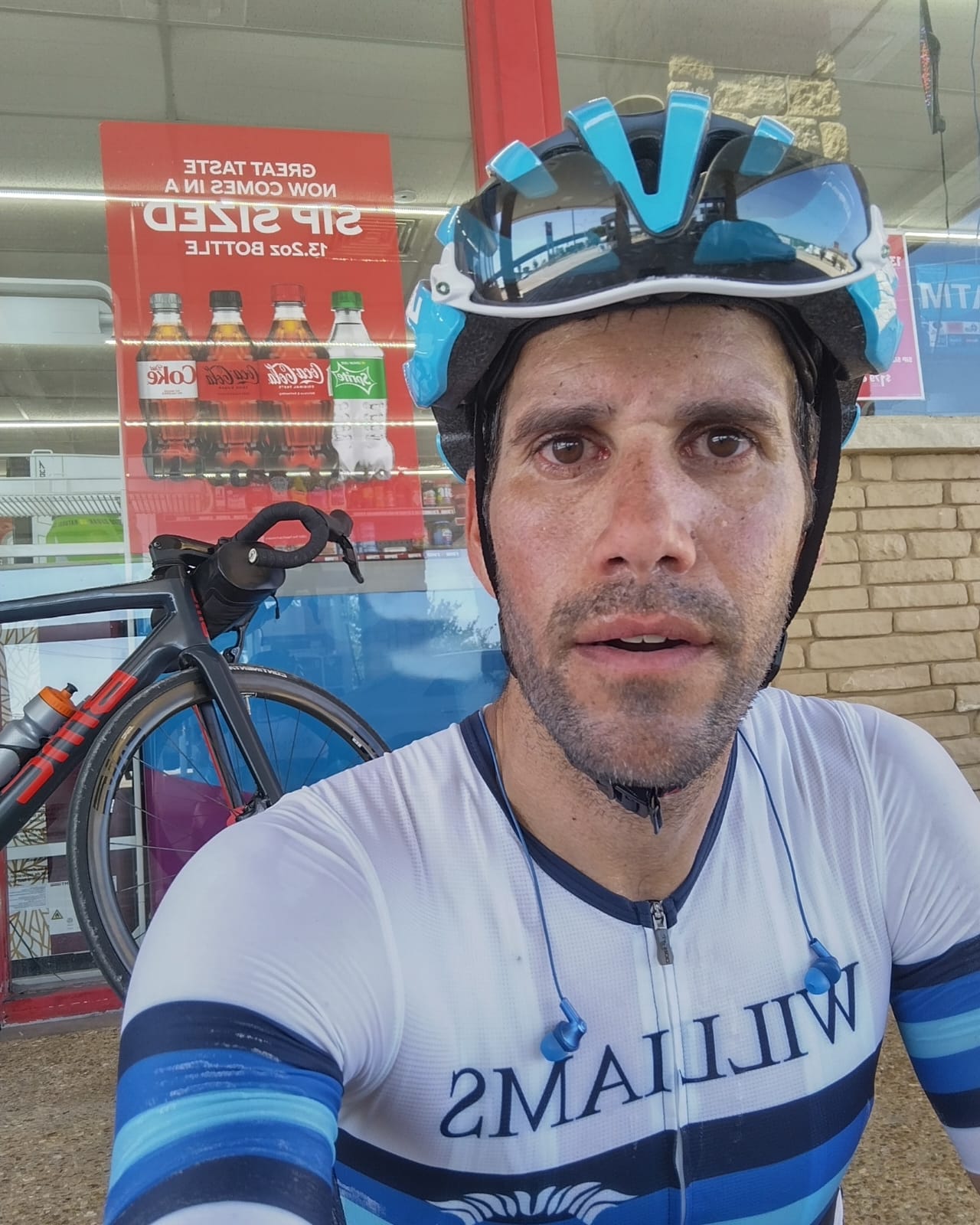
In the picture, I was sitting outside a Valero gas station somewhere between Waco and Temple. My eyes looked bloodshot, my expression was empty, and I had the distant look of an athlete whose body had run out of resources and whose mind had stopped negotiating.
Seeing that photograph brought the entire day back to me. It also reminded me that some of our most valuable experiences do not look like successes when they happen.
The Plan That Sounded Perfect Before Sunrise
My family and I were traveling to the San Antonio area to visit my in-laws. We planned to leave relatively early, but I came up with a more ambitious idea. I would wake up before everyone else, get on my bike, and begin riding south. My goal was to cover between 100 and 120 miles before my wife and kids caught up with me, loaded the bike into the car, and continued the rest of the trip together.
It sounded like a great adventure. There was no race number, finish-line banner, cheering crowd, or result sheet waiting for me. It was simply a personal challenge to see how far I could ride before my family reached me.
The morning started exactly as planned. I followed the same pacing principles I regularly teach my athletes by beginning conservatively, keeping the effort controlled, and preparing for the heat and cardiac drift that would eventually come. For the first part of the ride, I felt strong, the miles accumulated smoothly, and the plan seemed completely reasonable.
Then the sun began to rise.

The Heat Never Arrives All at Once
Heat rarely takes control of a ride in one dramatic moment. It works gradually as the sun climbs higher, the air feels heavier, the water in your bottles becomes warm, and your heart rate begins rising even though your power and speed remain unchanged.
You continue drinking, but a hydration deficit slowly develops and becomes harder to reverse. You may not feel terrible yet, but the balance has already begun shifting against you.
By the time I reached Waco, I still felt relatively okay. However, “relatively okay” can be a dangerous place during a long ride in extreme heat. You are not yet struggling enough to force yourself to stop, but you are beginning to realize that the original plan may no longer match the conditions around you.
I wanted to reach Temple and possibly continue farther south, but serious doubts started to appear as I left Waco. I questioned whether I had enough fluid, whether stopping would cost too much time, and whether I could simply push a little farther.
That final thought is often where a difficult ride begins to unravel.
When Progress Becomes Survival
Anyone who has gone too deep during a long ride understands the transition. At first, you are riding toward a destination. Later, you are riding toward the next place where you might find water, food, shade, or help.
The goal is no longer performance. The goal becomes survival.
I knew I should stop, get something cold to drink, eat, and allow my body to stabilize. However, I wanted to get as far down the road as possible. That desire can sound like determination, but from inside the effort, determination and stubbornness are often difficult to separate.
I continued until stopping was no longer a decision I was considering. My body had already made the decision for me.
I eventually saw a Valero gas station somewhere between Waco and Temple, about ten miles short of where I wanted to go. Ten miles may sound insignificant on paper, but when you are dehydrated, depleted, and beginning to cramp, those miles can feel impossible.
The moment I pulled into the station and got off the bike, I knew the ride was finished.
The Finality of Getting Off the Bike
There are times during a long ride when a few minutes in the shade, a cold drink, and some sugar are enough to bring you back. This was not one of those times.
It did not matter how many Cokes I drank, how much sugar I consumed, or how long I rested. My body had reached the end of what it could give that day. The cramps were beginning, the heat had collected its price, and I had exhausted my physical and mental reserves.
That was when I took the photograph.
I do not remember carefully framing the image or thinking about how I looked, but years later, it tells the story clearly. My face showed that there was nothing left to perform and no energy left to prove anything.
My wife and kids eventually arrived to pick me up and naturally wanted to know what had happened. The simple explanation was that I had attempted something difficult in the Texas summer heat, misjudged what the day would demand, and paid the price before reaching my destination.
However, that explanation does not tell the entire story.
The Difference Between Failing and Wasting an Attempt
If I judge the ride strictly by the original goal, it was unsuccessful. I wanted to reach Temple or continue farther south, but instead I stopped ten miles short and waited outside a gas station for my family to rescue me.
Years later, however, that was not the first thing I thought when I saw the photograph. What came back to me was how difficult the ride had been and how willing I had been to attempt it.
As endurance athletes, we often judge an effort only by the final result. We ask whether we finished the event, reached the destination, or completed the prescribed power targets. Those outcomes matter, but they do not explain everything we gain from an experience.
There is value in taking on a challenge that stretches you. There is value in discovering where your current limits are and learning how you respond when a well-designed plan begins falling apart.
Sometimes the most important lesson is not found in accomplishing the goal. Sometimes it is found in having the courage to attempt it and the humility to learn from what went wrong.
The Coach’s Dilemma: Consistency Versus Challenge
As a coach, I place enormous value on consistency. Most training sessions should not leave an athlete unable to function for several days. Effective training creates enough stress to produce adaptation without destroying the ability to return and train again.
The goal is not to prove how much suffering you can survive every week. The goal is to build fitness through manageable workloads, controlled intensity, appropriate recovery, and the ability to repeat quality work over time.
However, consistency does not mean avoiding every difficult challenge. There are moments when athletes need to stretch themselves through a demanding workout, race, long ride, or personal goal where success is not guaranteed.
A structured training plan prepares your body, but a meaningful challenge often reveals your character. It shows how you make decisions while tired, how you respond when your expectations no longer match reality, and where your physical or mental weaknesses may still exist.
That information can be valuable, but only when you are humble enough to accept it.
Do Something Hard, but Respect the Cost
The lesson from this ride is not that every weekend should become an extreme test of suffering. Taking yourself this deep has a cost.
These efforts can deplete you physically, disrupt several days of training, and create emotional fatigue that lasts longer than the soreness in your legs. When athletes stack too many extreme challenges together, those efforts stop building confidence and begin damaging consistency.
A meaningful challenge should include preparation, the challenge itself, proper recovery, honest reflection, and a return to regular training. Without recovery, growth becomes far less likely. Without reflection, you may simply repeat the same mistake.
Hard efforts can show you where the edge is, but you do not need to live on that edge every day.
Courage Is Not the Same as Recklessness
Looking back, I can admit that parts of the ride were foolish. I should have stopped earlier and responded to the warning signs before my body forced the decision. I allowed my desire to cover more miles to override the information my body was giving me.
That is not something I want to romanticize. Mental toughness does not mean ignoring basic judgment or refusing to stop regardless of the consequences. Sometimes the strongest decision an athlete can make is recognizing that continuing no longer serves the purpose of the day.
At the same time, acknowledging my mistakes does not erase the value of the attempt. Both things can be true: I made poor decisions, and I am still glad I tried.
The ride gave me a clearer understanding of heat, hydration, pacing, fatigue, and the point where determination can become self-destructive. More importantly, it left me with a memory of being willing to step into something genuinely difficult.
The Picture Means Something Different Now
At the time, I may have viewed the photograph as evidence of failure. Years later, it represents something else.
It represents a day when I attempted a difficult challenge, discovered the limitations of my plan, and returned home with a lesson that still matters. The suffering was real, the mistakes were real, and the disappointment was real, but so was the courage required to begin.
Not every challenge ends with your hands raised in the air. Some end outside a gas station, completely depleted and ten miles short of where you wanted to go.
That does not make the experience worthless.
What matters is what you carry forward. Did the effort teach you something about your limits? Did it expose an area that needs work? Did it give you a more honest understanding of yourself? Can you absorb the lesson, recover, and return to training with greater wisdom?
That is where the value of the experience lives.
What Will Your Challenge Be?
I am not suggesting that you copy this ride or treat stopping for water as a sign of weakness. I do believe, however, that every athlete should occasionally choose something that feels genuinely intimidating.
It may be a long endurance ride, a demanding race, a difficult workout, or a route you have always wondered whether you could complete. Prepare for it properly, respect the effort, and create enough space afterward to recover.
You may accomplish exactly what you planned, or you may come up short. Either way, pay attention to what the experience reveals.
Do hard things, but do not turn every day into the hardest day of your life. Recover, reflect, learn, and then return to the process.
A difficult challenge can show you what you are capable of, but consistency is what allows you to become more capable.
At Utmost Performance, consistency remains the key.